Showing posts with label fabric. Show all posts

Monday, February 20, 2017

a theoretical particle named after a laundry detergent


photos I took of my mother, 2012


I remember sitting in classes with her as a child, that we were at the Community College. I know as an adult that my mother was probably getting her AA in either child development or ornamental horticulture. I don't know how far she got in either. I remember vaguely her being involved in my earliest education, but am not sure in what capacity. There is just a clear picture in my mind of a day spent washing all of the dolls, a group activity for a roomful of post-toddlers, and how proud she was about that activity she had come up with because she still mentions it sometimes. Later, she helped run a preschool out of a church facility, since it wasn't in use during the week, and my little brother, the youngest of us, was one of those preschoolers. I remember the smell of graham crackers and apple juice, two things I can't bring myself to eat because of how strongly I associate them with the gummy residue on faces and hands that I helped clean up. Rubbing backs during naptime and thinking about my own preschool traumas. The flow of moms at the end of the day, questions they asked us about their children's behavior and eating habits. And so much sunshine, in all of those memories.


In high school I went with her sometimes when she taught classes on child development to child care providers looking for basic certifications. Most of these women were running daycare out of their homes, in trailer park neighborhoods and stripped down forgotten about parts of town, the rambling extremities close to the prairie, far past the shadow of the university that ran most of the town. We drove forever it always felt like, past the cornfield that did haunted rides every Halloween, to be in this lonely little class of women who didn't understand why hitting children was a bad thing. I was the silent witness in the room, the brevity of my mother's countenance held in my own awareness - there was a wooden spoon we were spanked with when I was little, I remember the year before starting my period, my stepfather making me pull down my pants so he could lay the force of his hand against my flesh. I suspect the child development courses she took shifted something in her perspective that my younger siblings didn't have to experience so much, and I do think that she had a very specific understanding of where these women were coming from. I watched her face as she listened to their responses to the material, accidental confessions from the 'students' that were often deeply disconcerting, to know that people left children in their care. But in some of these poor, far flung places, what other choice did they have?


Once, when my mother got to the section on breastfeeding, one woman who was hugely pregnant defensively informed the room that her 18 year old son wasn't breastfed and he was just fine, that breastfeeding was gross, was something animals did. I never saw judgement in my mother's face, she let them confess their fears and remarks about how children were viewed and handled. She merely rolled along, describing colostrum, the thin early milk rich in antibodies for helping construct the baby's immune system, then, a week later fats and vitamins come in, calories to support their ceaseless growth... by the time she finished telling the story of how our bodies adapt to the growing, shifting needs of our young, that same woman spoke up again. 'I had no idea', she said. 'This baby will be breastfed' she told us, with her hand on the broad expanse of her ripening body.


The education system was created in the wake of child labor laws, suddenly the working class needed somewhere to put their children while they filled the factories in the urban areas that exploded during the industrial revolution. It was designed to turn out the future workers to fill a rapidly standardized assembly line structure of production. After my time in public education, I have racked up countless hours studying for standardized tests, memorizing dates and facts that were disjointed, not connected to the history or circumstances they have evolved out of, and I have witnessed and fought with teachers who have brought my classmates to tears from deep condescension whose source I cannot know, but whose boundaries were limitless in the container of those classrooms where no one is around to see how hard we fought, as teenagers, to convince anyone that we existed. All I remember from economics are graphs and formulas that I didn't bother learning, since they were so far removed from my own experience of having been raised on welfare. While I struggle getting my head around adult finances, after having been raised by adults with no idea about their personal finances, I can't believe what we learn in economics has little to no connection to our place inside of the economy, or the agency we might find within it. We learn how to have sex, the hardening of parts and the hormonal responses in our bodies in sex ed, how genes interact to give us our mother's eyes or our father's eyebrows in biology... but never what comes afterwards - not how we grew inside of someone else's body, or how specifically our bodies adapt to such a massive event - like producing its own form of nourishment. I wish we learned about Pythagoras' arrival to his theorems, alongside wrestling with its product. What is the point of a class on current events without any frame of reference for what is happening in our very local government - something that both impacts us, and that we can impact as well? What an opportunity being missed, to build not just a richer community fabric by embedding its constituents more deeply into its awareness and expression, but also give a quickly maturing demographic a sense of where we belong inside of that vast, vague, overwhelming potential of the world, of the hopeless/hopeful statement 'You can be anything'? How do we learn about our relationship to the global community if not in the place we spend so much of our childhood?


How do we take the education of our children back? Like the asbestos and other chemicals I have had to wade through while renovating schools - we send them off, with so little awareness of what they will be taking in and how it will manifest later in their lives. While these generalizations may not apply to everyone's experience, I know I am not alone in having them, and feel very strongly that I can see now the threads that got lost in forming my sense of self, as well as the threads that got strengthened around my particular circumstances.


There were heroes and saints too. My favorite teacher my senior year, Mrs. Bergeron, had a quote over her door from Dante's Inferno: 'Abandon all hope, Ye who enter here' . I believe she went to Harvard, and wore tweed suits with skirts, and talked sometimes about how hard it was to teach us important things around what was required of them to teach to fit inside of those standardized tests. She was cold and serious, but when she told you that your writing was good... it meant more than Christmas ever has.


'It is not by coincidence that archaeologists find weaving tools and weapons side by side.'


Thursday, November 10, 2016

the thickness and thingyness of knowledge


linoleum block prints that I carved by hand


stencils cut from cardstock


posters designed for 2 very different choreographers


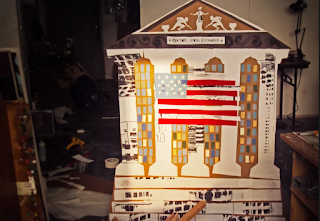
stock exchange building I designed to look like it came from
a child's inner landscape (for a narrative short film)


I've seen her glance at a particular place a number of times, a tucked in area underneath my ribs that I've always had. It showed up in the drawings by students when I was a figure model, I ignore it in the mirror. In a movement class, allowing myself to consider what it means to grow wide but stay fluid at the same time, she asked if she could touch me along the front of my ribcage, just above my belly. Her hand slid over that place where I fold in, held tight by my own sinew, and she asked me to soften underneath her fingers as I initiated a roll from my side onto my back. For just a moment I could feel my spine free, twisting on its own in the jelly of my being. I can't stop thinking about that sensation. That my body might stay together even if I didn't constantly try to keep it from falling apart. That there may lie underneath my skin an entire bodily experience that I have never had access to because of holding myself back. Up. In.

There was a baby the other day, in one of those classes, born sooner than expected and so small, and I imagine all of his systems were struggling to catch up to the amount of stimulation the world provides. When he got overwhelmed, this tiny human cried and cried, and I suspect every adult in that room felt a deep, primal response to the heart-wrenching sound of this little being declaring his existence with all the power of his developing lungs. So we listened while his mother rocked him, as we continued our individual actions. Maybe he cried out for the safety of the womb, we can't ever really know, but I felt his cries all the way down in my bones. Maybe there is a particular note being sung, that most animals can still recognize - a language we have forgotten - but his voice called it out of us, I could see it in the other women's faces. I tried to stifle the flashbacks of being trapped in the bathroom by my stepfather when I cried. His constant denial of my truth while I was growing up would burst out of me helplessly. Uncontrollably painful sobs led to hitched, repetitive breathing like hiccups trapped in a pathological loop, they would last forever. His hand holding the doorknob from the other side until I could breath normally, had control over myself. My mother's vicious words any time I tried to communicate to her when I was in distress. That I existed. That I had feelings and that they were being crushed. That I was being crushed.

I had to step outside to regain control over my face.

Since I was assisting, providing support to Facilitators and Caregivers with infants, this was not the place for me to be swimming in my own pain. But as I considered where my response was coming from, I realized for the first time that maybe it wasn't just Art School priorities that got in the way of me learning how to develop my self expression. Maybe I had already learned everyone else's needs and opinions were more valuable than my own. Maybe it isn't the men who have talked their way into my bedroom who robbed me of the ability to defend myself, perhaps it was always me, robbing myself of my voice. I am the one suppressing my ability to communicate how I feel. Since I never had a safe place to express it, I have no idea what could possibly come out of me - I am terrified that telling people how I feel means I will lose them or myself. Listening to the cries from those tiny lungs, I realized how long I've been moving through the world like I had that horrible man breathing in my face, like my mom's defensive, cutting words were true. That I brought them with me into my sexual encounters and my friendships. Their physical presence has long since evaporated from my life, but I've been reacting as though they have always been there. How have I not known I was free?

Later that evening I was one of 30 dancers in a performance art piece. The piece had no cues, just a sequence of scenarios that were equal parts choreography and improvisation. As we stormed and stomped through the tiny gallery space, we welcomed in 3 guests/audience members and randomly ignored them and focused on them as we also responded to each other. It took a specific kind of openness, where you could almost feel the energy of the room shift as bodies morphed into a new shape, a different pattern of movements. One of the transitions went from a fast, low to the ground stomping shuffle to locking arms and legs with any body close enough to grasp, anchoring to them and freezing. The 3 audience members watched a roiling sea of bodies suddenly coalesce around them into a sculpture, a coral reef, a gently breathing aquifer that air and space moved through, that they were held inside of.

Inside of the anchor, the kinetic landscape of our connected bodies, it is evident when the mass begins to shift because there is a subtle releasing of weight - the force moving through our points of contact with each other pours back into our feet - and slowly, we all find ourselves standing face to face with another body that becomes our Mirror. There is such a strange deep resonance in the mirroring, a silent exchange through our eye contact and a physical responsiveness that passes the role of leader and follower between us, that gives my limbs permission to be drawn into the rhythms and gestural nuances of another being with a consciousness that lives underneath the patterns I typically move within. We did 15 repeat performances in 3 hours, and almost every time I moved from Anchor into Mirror I was looking into a completely different face, open and hyper aware of a different heartbeat. Once I looked into the tremulous, watery blue eyes of a much older woman and felt something powerful soften inside of me as I let her lead my body in space. Another time my focus was tuned to a man who looked like he might have walked out of a Dostoyevsky novel, but with laughing eyes that I was helpless against. He slowly covered his face with his hands to give me the space to regain my composure as my hands followed, and we took a deep inhale together before the next wave of synchronized movement rippled through the collective. A few times, audience members folded themselves in with the performers, pulled in by a deep desire to be a part of us, and I ended up Anchored with one of them during the course of the evening. She became the partner I mirrored, my body responsive to this curious outsider, extending the fearless support and trust of the other performers by including her in the co-creation of this experience.

I started to understand how the body of performers was tapping into an ancient, primal awareness, and the presence of the audience members allowed them to feel the edge of that collective fabric, sometimes enfolding, other times shutting them out completely, like a wave pulling back from shore after it had reached out and engulfed you. What I discovered in that room was this potential that we all still possess - a primordial capacity to be connected to each other.

Maybe we have misunderstood our inheritance.


Wednesday, September 7, 2016

trying to manufacture a myth from the materials at hand


A woman comes to greet me.

Dragons wind their ink drawn scales around her fierce little body, laughter crouches at the corner of her dark eyes, and in the accented syllables that escape from her mouth, equal parts music and brusque staccato.

Leading us down the hallway, she pauses to point at a variety of looms, young people crouched over them, working patiently. Some small swatches of fabric tests are pulled out, and while she talks about the weave as experimental structure, I am distracted by the regular patterns they display. Clearly their intention was manifesting an architecture, but I suddenly had a sense of the development of fabrics like Scottish plaid, or the various patterns claimed by small African nations, how that architecture became a symbol for bodies of people, of a culture. It seemed vastly important, this idea of strength underlying aesthetic value, driving our instinctual relationship to form and function. Like a kaleidoscope I suddenly saw the relationships between weaving and community, how everything in our built environment is an expression of that from cell walls and bone tissue to cityscapes and culturally distinct neighborhoods.

We were documenting the deconstruction of a woven installation piece designed by two young Latin American architects, to be taken to a group in Oaxaca by the tattooed Filipino woman, and all around us are accents and cheek kissing and this ancient art form they all were involved in various aspects of and I could feel so clearly my lack of connection to history. My history. My profound lack of cultural presence.

The oldest known cloth that's been unearthed came from ancient burial sites, and death rites are some of the earliest distinctions between human and animal in our anthropological history. The 'patterned sky' we helped to disassemble was designed around a similar self awareness, of life after being a canopy, it was made to lead multiple lives, just like it tied into preexisting holes in the concrete wall it was threaded around. Histories layered on top of each other, meaning arising and dispersing as that wall falls under new eyes, gets viewed with a new lens. Our tattooed loom master brought a bunch of handmade cakes for everyone to break bread/cake together before tackling the walls with tools, and it felt like communion, like a ritual that was necessary to take part of. I took a bite of something out of respect for some underlying sacredness, but might have had more to do with my hunger for connection, the void where my roots should be, those internal pathways I never even knew existed.

My parent's generation who came of age during/right after the civil rights movements and the draft and the Vietnam war and the slaughter of MLK and JFK and the student riots - they were doing the hard work of tearing down the walls and institutions that were holding America back, but as those same people move towards their twilight years, they have less communities to feel apart of, have formed their lives around fearing and distrusting the desire to be connected for what might come with it, and I've come across articles and statistics about an age where loneliness is largely becoming the thing that walks our parents and their parents through the threshold at the end of their lives. In older cultures, still living closer to the earth, age is a highly valued part of the life cycle, and the rites and rules they keep are still connected to a sense of why they are doing them in the first place - but I live in a reality that covets newness, youth, where an accumulation of history is a Cardinal Sin. Even my grandmother communicates care through a scattering of 5 or 20 dollar bills we've all been handed throughout our lives, and I wonder if she feels like she has nothing else to offer us. As we continue to succumb to capitalism's appropriation of our individual traditions into seasonal profit, how does it erase the histories that created them, those grooves in time and space through which we have carved our existence, our identities, our path? As our relationship to the harvest fades, do we distinguish 'Fall' by a pavlovian response to the smell of pumpkin spice in the air? How many Pumpkin Spice Lattes will it take to fill the void in my memory of when my grandmother used to hand-make pumpkin pie, but gave in to the ease of the grocery store? What would happen if the moon suddenly stopped rolling along its samskara? How has its steady weaving across the night sky and through our bedtime stories and in our blood helped us to know ourselves?

If our species evolved out of nomadic family groups who weren't anchored to a specific plot of earth - then maybe we aren't creatures with literal roots and childhood homes, maybe it was always stories that connected us to each other in the river of time. Maybe we have confused the transubstantiation of idea to flesh as brick and mortar, as something permanent, a monument, rather than bearing the warp and weft for a spell, until we can pass it those younger than us. As we spin the yarn of our lives, shaping the fibers and coloring the thread with our individual fight for space and sustenance, shelter and connection, the care with which we craft our social fabric is what builds the walls and pathways we walk along, and I am becoming aware of the cut threads and gaps in my transmission. We are all momentary manifestations in a multi-generational artwork, claiming that responsibility might be our birthright and burden as a member of this human collective. The threads falter earlier in my family history than I can quite reach back into, but maybe I've been fumbling most of my life looking backwards, against the arrow of time, to figure out what threads are mine to bear before I can turn around and move into my future.

If something has no history, how can you prove it exists? How can I prove I exist?


The spider, along with its web, is featured in mythological fables, cosmology, artistic spiritual depictions, and in oral traditions throughout the world since ancient times.

Traditionally, the stories involving Spider Grandmother are narratives passed down orally from generation to generation. The
Hopi have the creation myth of Spider Grandmother. In this story, Spider Grandmother thought the world into existence through the conscious weaving of her webs. Spider Grandmother also plays an important role in the creation mythology of the Navajo, and there are stories relating to Spider Woman in the heritage of many Southwestern native cultures as a powerful helper and teacher.

Although accounts vary, according to mythology she was responsible for the stars in the sky; she took a web she had spun, laced it with dew, threw it into the sky and the dew became the stars.


The Fates were a common motif in European polytheism, most frequently represented as a group of three mythological goddesses (although the numbers differed in certain eras and cultures). They were often depicted as weavers of a tapestry on a loom, with the tapestry dictating the destinies of men.