What kinds of things can we use to express the way we communicate with each other? Protest art is often a way of capturing strong emotions with word and image to appeal to our audience. What other ways do we have to tell others what we are feeling? What kinds of symbols and images can help us visualize the impact of our words on the world?
Example: Fire can be used to show...
- Anger
- Feeling consumed
- Passion
- Spicy Food
- Spicy Language
Words can wake us up, shake us, allow us to release, to express, to vent, to voice or give voice to what is happening inside of us or between ourselves and others. Words can be sharp, stinging, sad, silly - we can use them to sing a song, cry for help, tell a joke. We can use a megaphone, a microphone, a cell phone - to breath fire or spit bars, sound comes out of us in the form of a story. Maybe - if we are lucky - there are people in our lives that can help us organize the tangled threads and crochet it all into a story quilt, so we can see ourselves and our lives more clearly - like a friend, a parent, a therapist, a stranger on the bus.
Ways we engage with each other:
- Comforting
- Laughing
- Wishing
- Vomiting
- Screaming
- Singing
- Preaching
- Performing
Day 1: The Brainstorm
Pair up (or be prepared to show an exchange between 2 individuals) and begin to explore what kind of interaction each pair wants to illustrate. Today is just about focusing on how to show the nature of the exchange without words - what does it feel, taste, look like to witness or be inside of this conversation? Is it a conflict, a memory, a wish for the kind of exchange that is not available right now? Is it familiar, an exploration of how you feel most seen or heard? How do we translate that into something tangible, metaphorical?
Create 4 sketches - to choose 1 for us to jump into media with during the next session - go wide and try out a bunch of different things before settling on the right one for you and your partner.
Initial Brainstorm
My work-in-progress/sketch
Day 2: Making the Piece
Utilizing the materials we have been exploring and maybe some of the techniques that we have practiced together, each pair will figure out what vantage point and materials most fit the quality of their individual communication styles - each person is responsible for their part of the conversation/piece, but the 2 should fit together to tell us a story about the relationship between the 2 parts.
Previous student work:


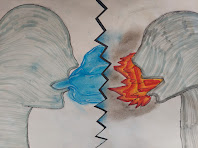


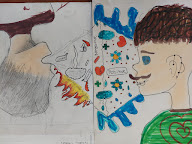


Interactions
Project @Hudson
The idea:
You are creating a piece of art that explores an
interaction/conversation between 2 people – but not with words. Your job is to
explore how to communicate the feeling of the words coming out of each person,
and the way it lands on the other using colors and shapes that represent the
exchange taking place.
Example:
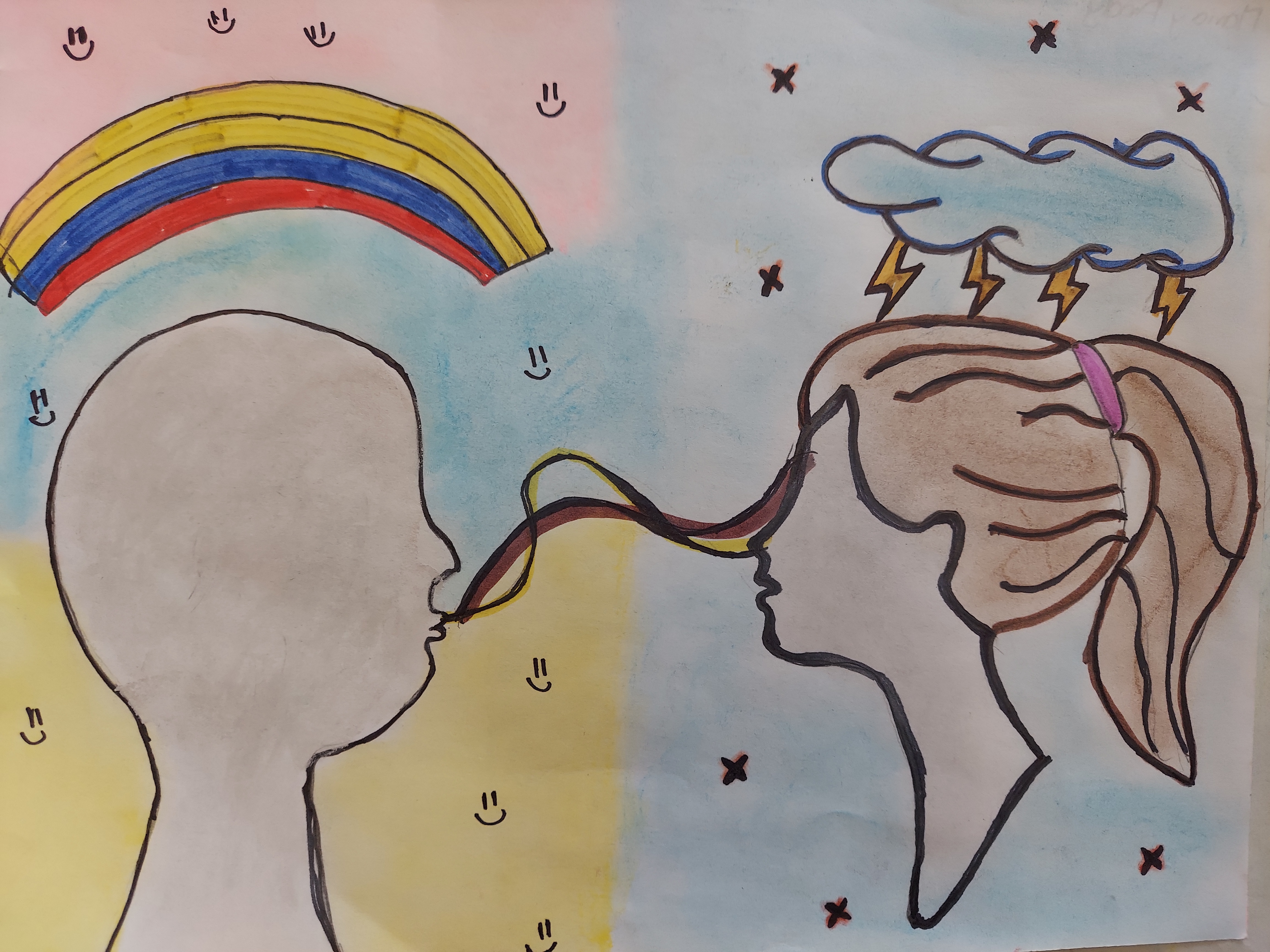
Anger can feel hot and out of control like fire, it can feel
cold and vicious like a million teeth – we might all understand our anger
differently. If someone comes to you with angry words that are like fire, how
do you respond? Do you bring fire back? Do you put it out with a wave of cool
water? Do you create an impossible to penetrate stone wall, keeping yourself
and your feelings contained and protected?
If you are showing a warm and loving conversation, or two
people who are talking that really see or get each other – how can you show
that warmth coming out of one person and touching the other? Is the
conversation like a fire that warms both people? Is one person’s words like
sunshine on the face of the other person? Is the warmth or light calming or
disappearing the storm inside of the other person? Is one person seeing the
starlight contained in the other person?
I want to feel this art piece from across the room, not
read it. I want the colors and shapes to tell a story with things that we
can FEEL. You decide what kind of conversation you want to show – maybe it
is a conversation you are still thinking about, or one you wish you could have –
that is up to you. Everyone needs to use a minimum of 3 types of art
materials on their piece.
Day 1: Sketch your idea onto the nice paper
Day 2: Everyone is going to do a watercolor
wash over the whole piece – using a color on each part of the conversation that
informs the feeling (I will show you what I mean)
Day 3: Adding layers of other media on top,
however you want to render your piece – Oil pastel, Chalk pastel, Acrylic paint,
Markers, Colored pencils, Pens, Printmaking stuff, Watercolor
Day 4: I will not be here, there will be
another teaching artist in my place – all those materials will be out, it will
be a work day
Day 5: Finishing your piece completely.
Last day to work on it.




No comments:
Post a Comment