Sunday, March 30, 2025

Name Game @APR

 Day 1

History of Graffiti - The Bronx is Burning


In the 1980's and 90's, after years of political de-investment in the Bronx - from Urban Renewal campaigns, redlining districts, the removal of all firefighters from those same districts etc - Landlords began intentionally burning down buildings to sell the real estate and capitalize on insurance, with institutions like Columbia and developers with plans to gentrify beleaguered neighborhoods chomping at the bit to access the South Bronx. The displaced communities fought back in the ways they had available - they rapped and rhymed their stories into popular song form, danced on the rubble of their homes and spray painted proof of survival on the subway trains that carried the message from the Bronx to the other boroughs. Hip hop and Graffiti arose as a heartbeat and symbol of resilience - spreading to other downtrodden urban environments like Chicago and Oakland, eventually finding their way into mainstream avenues of engaging with art and the collective. Evidence of the impact of these artforms is all around us - from the most recent superbowl halftime show to fashion week runways and in popular magazines and large scale brands we see every day.


Hip Hop culture goes mainstream:


WildStyle is a typeface/way of making letterforms that originated in NYC - a clear signal in other environments where you are from, kind of like having an accent. There are styles that are distinct to other regions. We are going to design our own style of letters, unique to us - and that might tell a story about who you are. From there, we are going to explore colors, textures and shapes that further give a sense of self that speaks as loudly as your literal voice.


Step 1 - How to build your style


On a practice piece of paper (while I demo on the board):
1. Draw a simple letter

2. Use the line of that letter as a skeleton to create a similar letter shape around it

3. Add or change something about your letter shape, getting wilder or bigger - exaggerate more then you think you can or should.


Step 2 - Getting creative with texture and shape


4. On your sketch paper, draw a skeleton of your name - smallish, since you might change your mind and try a different one - using a shape outline to start

5. Draw the letter forms around the skeleton and see how they fit into your shape - do you need more space? do the letters need to be arranged differently? Are there places where it feels nice to break out of the shape/boundary?

6. Think about some shapes and textures that feel like you - bubbly/spiky/hidden or camouflaged/easily distracted/full of energy etc - sketch some ideas you want to use in your final design

7. Sketch your design on a clean piece of paper - get as far as you can so we can add color next week!


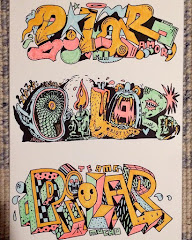
Day 2
Step 3 - Playing with color + background


Each piece needs to have: 
1. At least 3 colors, not including black
2. At least 2 textures somewhere in your piece
3. EITHER your entire name OR entire background must be filled in with color and texture (or both, up to you)

There will be colored pencils and markers available to fill in either the background or the inside of your letters - test out some of your textures or shadows etc on scratch paper to make sure you like what you are planning to do. If you don't know what to add, I am going to come by and work with you/challenge you to try some things.

I am going to withhold fine line/sharpies till the second half of the session, and will hand them out when it looks like someone is ready for that as the last piece.


*Secret step (If you are feeling brave) - adding figures and symbols


*This part is not required, but could be really cool if you feel compelled to really get into it.


A few versions I've been playing with:


\


Student Work:


Final Color!


Student Work:


Thursday, February 20, 2025

Descent into the Self: Project 2 @APR


Day 1: Life Journey/Personal Reflection/Brainstorm

Main goal for today is to have notes that respond to each of these 3 main questions/concepts for a board game that might be an exploration of your life. Don't worry about whether things are good or important enough - just write everything down, so you have more resources to play with later.


1. Environment Design 

(Group brainstorm about what that could look like, 5 minutes to record)

+ What environments describe our life? Are there multiple? 

+ Do you want to build a game based on your life out of real/literal things? Or are there symbolic landscapes that feel more evocative?

+ What are some possible landscapes we could us to describe our experiences? (An airplane taking us to different countries, a treasure map, a moon landing, a river?)


2. Obstacles - things in our lives that slow us down or force us to deviate in our path 

(Group brainstorm about what that could look like, 5 minutes to record)

+ What is an obstacle? What are some ways they might manifest in someone's life?

+ What obstacles have we faced, or expect we might have to come up against at some point?  

+ What could we use to represent those obstacles? (Anxiety Monsters, Walls, Sisyphus etc)


3. Pathways through Life

(Group brainstorm about what that could look like, 5 minutes to record)

+ What does your path look like? Smooth? Rocky? Like a maze, a garden, a golden brick road, a stairway to heaven? What are some different kinds of pathways?

+ What support structures exist in your life? (Family, friends, religion, sports, time/coming of age/future plans?)

+ What could we use to represent them? (bridges, helping hands, ladders, time warps?)

+ What are your goals? (To get through High School, to become an adult, to pass regents, to know yourself?) 


Day 2: Intersections + Map Making

Look at different kinds of Board Game play styles, pathways


Some basic gameplay structures:

1. Pathways heading to a destination or outcome

2. Traps/walls/blocks - things that slow down a player

3. Gifts/jumps/magical bridges

4. ?


Draft initial components:

Core rule requirements to be considered:

1. How do players move + escape obstacles

2. How does this game incorporate personal experiences into gameplay?

3. What needs to happen for the game to be concluded? What is the goal of the game and how is it achieved?


As soon as you are ready to begin on your final piece - present your sketch to receive materials. By the 3rd session on this project, we will all be constructing our games. 

Our 4th session on this project will be playing each other's games.


My version:


Final Day:

1. Everyone will have 5 to 15 minutes (depending on the class) to organize their games to be played.  We will be consolidating tables and bodies so each section has 4 games and 4 bodies to play them.

2. Find a section that does not contain your game. You will have 5 minutes to explore/play/make up rules to one of the games in that section. after 5 minutes, each group will find a new table and get 5 minutes to explore/play/make up rules.

3. After we switch 5 times, each group will answer these 3 questions:
    
    A. What is something you noticed?
    B. What was something you enjoyed?
    C. What would you do differently next time?


IF YOU DO NOT HAVE A GAME, HERE IS YOUR ALTERNATE ASSIGNMENT FOR PARTICIPATION POINTS - 

Letter To The Self:

Go back step by step to earlier versions of yourself. Each step of the way pause to notice what is different, and what is the same about these earlier selves. What did you have to give up or let go of to grow, and what did you gain in return? What would you want these earlier versions of yourself to know about you now, about the world, about the way thing work or turned out?

The rest of this final session will be writing a letter or making an art piece to that younger self. You can be done when you are ready to be done.